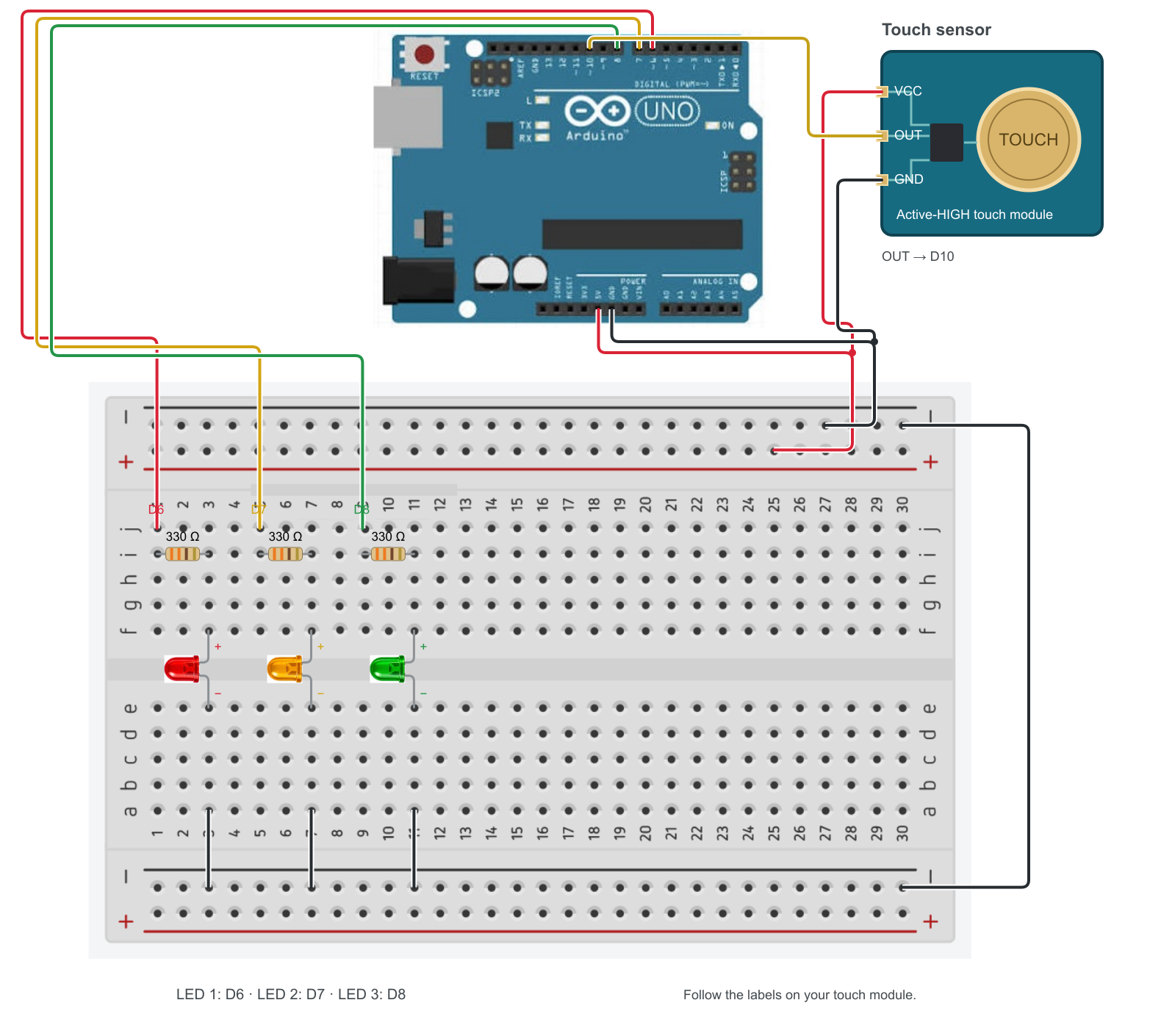
Project 11
Touch sensor — cycle LEDs
The code.
// Declare

const int TOUCH_PIN = 10;

const int LED_1     = 6;
const int LED_2     = 7;
const int LED_3     = 8;

// Variables to keep track of the system state
int cycleCounter = 0;         // Keeps track of which LED should be on (1, 2, or 3)
int currentTouchState = LOW;  // Current reading from the digital pin
int lastTouchState = LOW;     // Previous reading from the digital pin

void setup() {
  Serial.begin(9600);

  pinMode(TOUCH_PIN, INPUT);
  pinMode(LED_1, OUTPUT);
  pinMode(LED_2, OUTPUT);
  pinMode(LED_3, OUTPUT);

  // Turn on the first LED immediately at startup
  updateCycleLEDs();
}

void loop() {
  // Read the current state of the touch sensor
  currentTouchState = digitalRead(TOUCH_PIN);

  // Check if the sensor just changed from LOW to HIGH (a fresh touch)
  if (currentTouchState == HIGH && lastTouchState == LOW) {

    // Move to the next LED in the sequence
    cycleCounter++;

    // If it goes past 3, reset back to 1
    if (cycleCounter > 3) {
      cycleCounter = 1;
    }

    // Update the physical LEDs to match the counter
    updateCycleLEDs();

    // Print to monitor for debugging
    Serial.print("Touch detected! Active LED: ");
    Serial.println(cycleCounter);

    delay(50); // Small software debounce delay to prevent double-triggering
  }

  // Save the current state as the last state for the next loop run
  lastTouchState = currentTouchState;
}

// Helper function to turn off all cycle LEDs and only turn on the active one
void updateCycleLEDs() {
  digitalWrite(LED_1, LOW);
  digitalWrite(LED_2, LOW);
  digitalWrite(LED_3, LOW);

  if (cycleCounter == 1) {
    digitalWrite(LED_1, HIGH);
  }
  else if (cycleCounter == 2) {
    digitalWrite(LED_2, HIGH);
  }
  else if (cycleCounter == 3) {
    digitalWrite(LED_3, HIGH);
  }
}